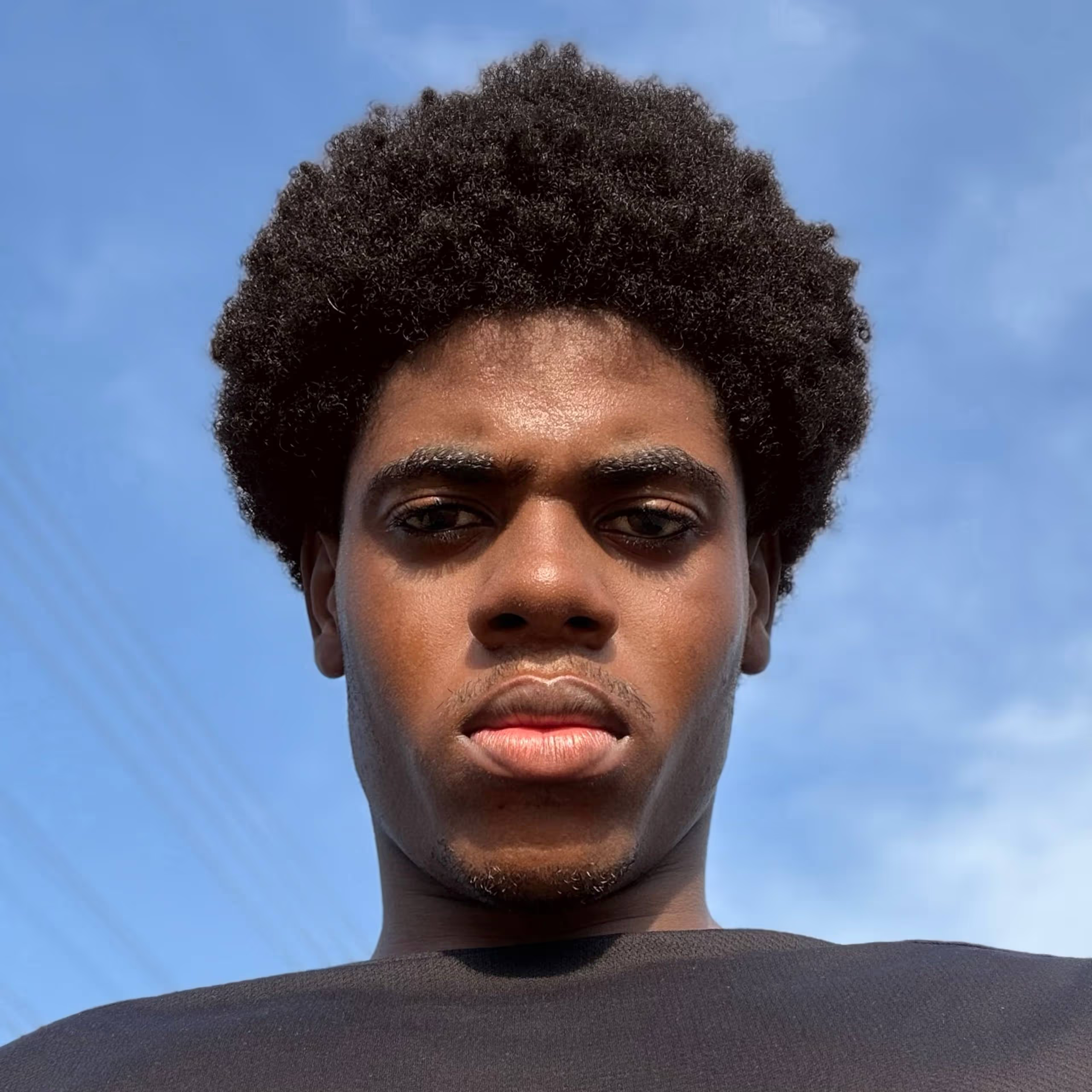

I built Blackmaxxer because most face analysis products are not built for Black faces.
That sounds obvious once you say it plainly. It is less obvious when the product wraps itself in charts, ratios, and the language of objectivity.
A lot of beauty software claims to measure harmony. What it often measures is distance from a template.
That template is rarely named, but you can feel it.
Full lips get framed like a compensation problem. Broader noses get treated like something to correct. A wider midface, fuller lower third, or wider-set eyes get marked down when they are normal, harmonious, and often attractive within Black facial norms.
If the reference point underneath the product is narrow, the output will be narrow too. Clean UI does not fix that. Math does not magically make the assumptions neutral.
That was the starting point for Blackmaxxer.
The Problem
I kept seeing products that looked scientific but felt wrong.
Not wrong in a dramatic way. Wrong in a quieter way. The kind of wrong that shows up when a user reads the report and walks away with the feeling that they got penalized for looking like themselves.
That is a design failure.
If you are going to score faces, you need to know what you are scoring against. If you are going to talk about aesthetics, you need to know when a feature is a genuine issue and when it is simply outside somebody else’s default frame.
I did not want to build another product that quietly teaches Black users to read their own faces through someone else’s lens.
What Blackmaxxer Is
Blackmaxxer is an AI-assisted facial analysis product for Black men and women.
The job is simple in theory:
- analyze facial structure, symmetry, proportions, skin, and grooming
- score features against ethnicity-aware reference norms
- explain the result in plain language
- give practical, non-invasive advice on how to improve
The last part matters the most.
I am not interested in building surgery fan fiction. Most people do not need a machine telling them how to become a different person. They need sharp feedback on what they can do with grooming, skincare, fitness, styling, and consistency.
That is the lane.
The Rules I Wanted the Product to Follow
Ethnic context is not optional
A broader nose is not automatically a flaw. Fuller lips are not automatically overprojected. A denser brow, a slightly longer lower third, or a wider alar base can be completely normal and attractive in Black faces.
If the system cannot account for that, the output is garbage no matter how polished the interface looks.
Numbers first, interpretation second
The pipeline starts with deterministic scoring: landmarks, ratios, region analysis, symmetry checks, skin cues. Then the language model explains what those measurements mean.
That separation matters.
I do not want a model inventing numbers because it liked the vibe of a face. I want the measurements anchored first and the interpretation layered on top.
Advice has to be usable
A report that says “improve grooming” is lazy.
Useful advice sounds like this:
- get a fresh fade every 2 to 3 weeks instead of letting the sides blur out your face shape
- stop dry shaving if razor bumps are wrecking your jawline
- use niacinamide in the morning and azelaic acid at night before you reach for stronger actives
- if body fat is hiding your jaw and cheeks, expect visible facial changes after 8 to 12 weeks of consistent fat loss, not in five days
People do not need generic encouragement. They need direction.
The tone should respect the user
I hate the fake-clinical tone a lot of these products use. I also hate the opposite extreme where everything is soft, vague, and padded with reassurance.
The right tone is direct.
Tell people what is already working. Tell them what is holding them back. Tell them what is fixable. Tell them what is probably not worth obsessing over. Then give them a plan.
The Hard Part Was Not “AI”
The hard part has not been adding a model to a pipeline.
The hard part has been getting the product to behave like it has a point of view without turning it into nonsense.
That means dealing with questions like:
- how to score harmony without flattening ethnic variation
- how to separate soft tissue problems from underlying bone structure
- how to talk about skin in melanin-rich faces without overcalling PIH, inflammation, or texture
- how to make reports specific without letting the prose collapse into generic AI sludge
- how to keep a long report structured while still making it feel personal
That is where most of the work lives.
Not in the model. In the constraints.
In the schema. In the scoring assumptions. In the report structure. In the prompt discipline. In refusing to accept vague output just because it sounds smooth.
What I Want the Report to Feel Like
The bar in my head is not “good enough for an AI product.”
The bar is closer to this: if someone paid a sharp image consultant or aesthetician to look at their face for ten minutes, what would they actually say?
Not content marketing. Not therapy. Not robotic dermatology notes.
Something more like:
Your eye area is already strong. Your skin is costing you points. Your grooming is leaving easy gains on the table. Your jaw looks softer than it needs to because of body fat, not because your structure is bad. Fix those three things in the right order and your whole face changes.
That is the target.
Why I Made It Public
I could have kept Blackmaxxer as a private experiment.
I turned it into a product because I think there is room for software that takes Black users seriously in categories where they are usually treated as an afterthought.
Not every product needs to pretend it is for everyone. Sometimes the right move is to build for a specific group directly and unapologetically.
That is what Blackmaxxer is.
A product with a point of view.
A product that starts from the assumption that Black faces should be read on their own terms.
And, if I do the job properly, a product that gives people advice they can actually use.
What I’m Still Tightening
The product is live, but there is still a lot I want to improve:
- sharper reports
- more specific protocols
- better PDF output
- stronger product recommendations
- clearer separation between structural limitations and fixable issues
That matters to me because I do not want to ship a pretty wrapper around mediocre advice.
If Blackmaxxer works, it should work because the output feels grounded, specific, and honest.
That is the standard.
If you want to see what I am building, it is here: blackmaxxer.com.